Showing posts with label Robotic. Show all posts

Robotic trousers to help paraplegics walk again

A revolutionary exoskeleton , a bionic walking device that allows paraplegics to stand and walk up stairs has gone on show in the UK's largest technology exhibition for the disabled, Naidex National.

The pioneering bionic device, called ReWalk, is the brainchild of engineer Amit Goffer, founder of Argo Medical Technologies, a small Israeli high-tech company.

He said the RoboCop-style suit would be an ideal device for injured British soldiers.

The robotic system, which requires crutches to help with balance, consists of motorized leg supports, body sensors and a back pack containing a computerized control box and rechargeable batteries.

The user picks a setting with a remote control wrist band - stand, sit, walk, descend or climb - and then leans forward, activating the body sensors and setting the robotic legs in motion.

The system will be available for £50,000 to personal users by the start of 2012.


Source - DailyMail.co.uk , Telegraph.co.uk


~ Library of weird and wonderful news blog ~

Swiss scientists create Flying Ping Pong robots

Scientists from Switzerland have created floating robots called quadrocopters that are able to keep a ball in the air by bouncing it between them.

The robot were created by researchers at the Swiss Control of Distributed, Autonomous Systems (CDAS) laboratory in their Flying Machine Arena in Zurich. They are capable of synchronized choreography, acrobatic tricks, and extremely precise movements.

Equipped with a tennis racket on top of them, the duo bounces the ball around a netted-off section of a Swiss building. Both units are controlled by humans (for now), but could theoretically be programmed as well.


Do they look like a robot in Transformers movie? :)


Via - Tom Chivers , Telegraph.co.uk and CBS News


~ Library of weird and wonderful news blog ~

Brain-Controlled Robotic Arm Fast-Tracked, Available in Just Four Years?

Recent developments in the field of robotics - Within six months DARPA will begin implanting chips in five patients’ heads to begin clinical trials. Those patients will be monitored for a year to see if chip function degrades or if bodies reject the chips. If the trials are successful, that four or five year timeline for commercial availability is realistic.

Read more at  Popular Science


~ Library of weird and wonderful news blog ~

South Korean scientists develop walking robot maid

South Korean scientists develop walking robot maid picture

South Korean scientists have developed Mahru-Z (R), a walking robot maid which can clean a home, dump clothes in a washing machine and even heat food in a microwave.

Mahru-Z has a human-like body including a rotating head, arms, legs and six fingers plus three-dimensional vision to recognise chores that need to be tackled, media reports said Monday.

"The most distinctive strength of Mahru-Z is its visual ability to observe objects, recognise the tasks needed to be completed, and execute them," You Bum-Jae, head of the cognitive robot centre at the Korea Institute of Science and Technology, told the Korea Times.

"It recognises people, can turn on microwave ovens, washing machines and toasters, and also pick up sandwiches, cups and whatever else it senses as objects."

The institute took two years to develop Mahru-Z, which is 1.3 metres (4.3 feet) tall and weighs 55 kilograms (121 pounds).

It could also work with an earlier maid robot called Marhu-M which moves on wheels, since both can be remotely controlled through a computer server.

You claimed Mahru-Z as the most advanced robot in terms of mimicking human movements.

Apart from tackling chores, researchers say it could also be used in conditions too difficult or dangerous for humans. But mass production for commercial use is some way away.

The science institute spends about about four billion won (3.5 million dollars) every year on robot research. It began receiving state funds for the project in 2006.


Via - AFP

2010 CES as world's largest consumer tech tradeshow - The next big thing is robotics

A record number of new exhibitors - more than 330 companies - will join more than 2,500 exhibitors in unveiling their latest technology innovations at the 2010 International CES. With more than 20,000 new products on display, the International CES is the world’s largest consumer technology tradeshow. CE Spotlights throughout the CES show floor will feature key market categories including apps, green technology, gaming, location based services and more.

“With a record number of new exhibitors, scores of new product introductions, several new Spotlights on the show floor and a dynamic lineup of keynotes sessions, the 2010 International CES will be our best show yet,” said Gary Shapiro, president and CEO, CEA. “More technology deals will be made during the four days of CES than anywhere else on earth. In fact, each CES attendee has an average of 12 meetings while at the show, reinforcing CES as the business hub for technology. Innovation is flourishing within the technology industry and the 2010 CES is the only place to see it all.”

Several CE Spotlights covering a variety of technology categories will be housed on the 2010 CES show floor. These include: the iLounge Pavilion, featuring all things iPod, iPhone and Mac related; Living in Digital Times, highlighting technology relevant to all lifestyles; EHX@CES with custom CE products for home and commercial installation; Sustainable Planet, featuring the latest green technologies including advances in green building, alternative energy technologies and smart grid technologies and the Gaming Showcase with the latest gaming hardware and software.

The 2010 CES will feature 20 market-specific TechZones, highlighting the latest trends and emerging markets. New CES TechZones include the eBooks, Experience 3D, Femto, Lifestyle Gadgets, Mobile DTV, Netbooks and Safe Driver TechZones.

Top executives of the biggest names in technology and business will take the stage at the 2010 International CES with keynote addresses from Microsoft’s Steve Ballmer, Ford’s Alan Mulally, Intel’s Paul Otellini and Qualcomm’s Dr. Paul Jacobs, as well as Nokia’s Olli-Pekka Kallasvuo and Hisense’s Zhou Houjian, who will speak as part of the CES Technology and Emerging Countries Program.

Additionally, the 2010 CES will feature more than 250 sessions and 800 expert speakers as part of the CES conference program, which will cover a range of industry topics from social media to safe driving to technology policy. Conference programs for the 2010 International CES include, “Up Next at CES: Creativity, Content and Cash,” focused on addressing the major challenge of how to monetize new media and the “Tech Policy Summit,” which will discuss critical policy issues including broadband deployment and spectrum allocation.


I-Fairy, a 4ft tall humanoid robot made by Kokoro of Japan, will make its debut, welcoming visitors and responding to questions in its own voice, making natural gestures with head and arms as it speaks.

"The next big thing is robotics. Sometime in the next several years, robotics as a consumer phenomenon is going to take off," says the forecaster and essayist Paul Saffo.

Ray Kurzweil, futurist and chancellor of the Singularity University set up in Silicon Valley this year, technology will soon take us much further, with "nanobots" able to replace or repair any part of the body.

His book The Singularity is Near , which inspired the academic institution, predicts that the exponential rate of innovation is sending us racing towards a future where enhanced humans will work with super-intelligent machines to solve the world's problems.


Source

1 - International CES

2 - The Financial Times

World's First Bionic Fingers by Touch Bionics

Scientists from Touch Bionics, the Livingston, West Lothian company claimed that the motor-powered ProDigits bionic fingers that was used by a former concert pianist, Maria Antonia Iglesiast are the world's first bionic fingers.

Maria, from Catalonia, Spain, said the devices allow her to pick up a glass, hold cutlery and write for the first time since she lost her digits after an illness.


The fingers were made by the inventors of the bionic i-Limb hand when they realised more could be done for the estimated 52,000 partial-hand amputees in the EU and 1.2 million people worldwide who have missing digits.

It is estimated that a two-finger amputation leaves an individual with a 20-40 % hand impairment, depending on which fingers are affected.

Ms Iglesias, 42, lost hers after developing pneumococcal septic shock in 2003.


She is among the first to get Touch Bionics' custom-made devices, called ProDigits, which cost between £35,000 and £45,000.


"I am very pleased to be part of this project and the benefits my new hand is giving me are like a dream," she said.

"Even a simple thing like holding and lifting a glass of water to drink from was impossible before, but with ProDigits I can do it easily."

The fake digits, which are covered in a hi-tech robotic skin, are controlled by "myoelectric sensors" which register signals from any muscles that remain in the hand. Alternatively, they can be activated by a pressure-sensitive touch pad.


Via - Sky News

International Robot Exhibition 2009 footage and photos


iREX - International Robot Exhibition 2009 video


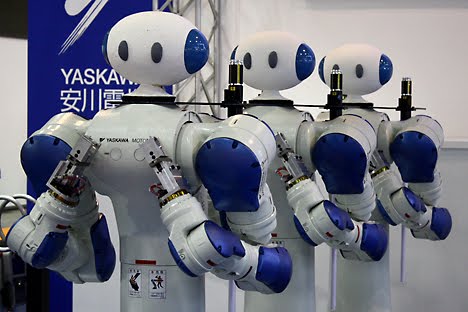
Yaskawa Electric Corporation displayed a variety of Motoman industrial robots


An Actroid was on hand at Kokoro’s booth to demonstrate new camera-based face mimicking technology


Fuji Heavy Industries (Subaru)


TOPIO, a ping pong playing robot by TOSY (Vietnam)


The iRobi home robot by Yujin (Korea)


NT Research (Korea) demonstrated their RAMeX humanoid with tele-operated arms and hands.


An intelligent building guide robot with arms, speech capabilities, and face/voice recognition skills was on display at the “Premium Korea” booth.


Alderbaran Robotics (France) exhibited Nao, a fully-programmable autonomous humanoid.


NEDO also exhibited a Muratec receptionist robot.


A mini-humanoid blended into the crowd.


Kawada Industries demonstrated their NEXTAGE next-generation industrial robot.


HIRO humanoid upper body for R&D purposes.


Figla exhibited an interactive robot (prototype) with remote camera.


Photos source - Pink tentacles

Legal expert warned about the robot's human rights


Society must decide if it is willing to accept relationships between humans and robots before the machines become so sophisticated they start demanding rights, a legal expert has warned.

Rapid advances in technology mean cyborgs, or human-like robots, are no longer a vision of a distant future.

The machines have been made famous by films like Terminator and Blade Runner but real life is increasingly catching up with fiction.

Earlier this year researchers announced they had created robot ‘scientists’ – complete with the ability to think for themselves.

As the machines become more sophisticated, they will increasingly seem more like humans and could demand ‘human rights’, Anna Russel, from the University of San Diego warns.

One of the flashpoints could be over relationships, including sexual relationships, with humans, she claims.

In an article titled “Blurring the love lines” she warns: “While this humanoid is a giant leap forward technologically, if a self-aware, super-intelligent, thinking, feeling humanoid is developed, the legal system will be hard-pressed to distinguish this creature legally from human actors on grounds not stemming from a religious or moral prejudice.”

Lawyers have to start thinking now about what rights should be accorded to cyborgs, she argues. Most societies will want to regulate such relationships but Russel claims they have to prepare themselves for how they would respond if the cyborgs clamoured for sexual freedoms.

As the technology improves “it will be inevitable that legal issues would be raised and the love lines blurred,” she warns.

“In what way would such sexual activities be regulated, however, and how regulation would work is not clear.”

The article is published in the journal Computer Law and Security Review.


Via - Telegraph.co.uk

Swine flu H1N1 Robot unveiled

A robot designed to help doctors and health care workers diagnose Swine Flu was unveiled at the Security & Safety Trade Expo in Tokyo, Japan Thursday. It exhibits symptoms of the H1N1 flu virus.


The robot is coated in a human-like skin. With its animatronics, it sweats, moans, cries and convulses just like a human would when infected with the H1N1 virus.

If the robot is not treated properly the symptoms gradually get worse and the robot stops breathing.

The robot was one exhibit amongst many others at the show aimed at either helping prevent or aiding treatment of the H1N1 Flu.


Via - wbko.com

The world's tallest two legged robot that can play soccer


The world's tallest two legged robot can play soccer


This Unit 33 robot is 7 feet tall which made him the world's tallest two-legged robot. He can also walk, turn, twist, take a bow and amazingly play soccer.


Via - New Launches

Russian robotic soldier revealed in Moscow

A prototype track-mounted combat platform tailored to use Russian weapons has been unveiled at an arms show in Moscow. Producers say it beats the similar American bot widely used in Iraq and Afghanistan campaigns.


The bot, called MRK-27-BT, was produced by the robotics lab of the Moscow Bauman Technical University. It was shown to the public at the Interpolitex-2009 arms exhibition.

MRK-27-BT’s standard armament includes two Shmel rocket launchers, two grenade launchers, a Pecheneg machine gun with a 100 round ammunition belt, and six smoke grenades. It is operated with a couple of joysticks and has a maximum range of 500 meters. All the weapons are standard issue used by human soldiers and can be detached in the field.

The project is similar to SWORDS, a weaponized version of Foster-Miller’s TALON platform. While the platform is extensively used by US military for disposing of explosives and other tasks, the real weapon-wielding bot was never used in actual combat.

Russian developers say their project beats the American counterpart in mobility and speed thanks to a superior track design. Its weapon mount is more flexible and can extend over a foxhole edge. It also has a built-in recoil suppressor. At the same time the Russian robot is larger, standing 1.5 meters tall with its mount raised, while SWORDS is barely knee high.

Designers hope that Russian Defense Ministry will order a trial series of the platform. However, according to RIA Novosti’s sources, top brass want a developed doctrine about the use of combat robots before committing.


Source - Russia Today


Scientists develop more quieter robot

A team of robotics engineers from University of Nevada in Reno have developed a system that makes pneumatic artificial muscles much quieter than before.

Annoying noise produced by air pumps or electric motors in human-like robots is among the factors hampering their entry into consumer market. Researchers came up with an idea how to make artificial muscles work silently.


Metal hydrides can undergo a process called reversible chemisorption, allowing them to store and release extra hydrogen held by weak chemical bonds. It's this property that has led to the motor industry investigating metal hydrides as hydrogen "tanks" for fuel cells.

To make a silent artificial muscle, Kwang Kim and his colleague Alexandra Vanderhoff first compressed a copper and nickel-based metal hydride powder into peanut-sized pellets. They then secured them in a reactor vessel and pumped in hydrogen to "charge" the pellets with the gas. A heater coil surrounded the vessel, as heat breaks the weak chemical bonds and releases the stored hydrogen.

The next step was to connect the vessel to an off-the-shelf artificial muscle, which comprises an inflatable rubber tube surrounded by Kevlar fibre braiding. Two of these placed either side of a robotic joint can mimic the push/pull action of muscles by being alternately inflated and deflated (see diagram).


Turning the heater on and off controls the flow of hydrogen into the rubber tube, causing the muscle to move silently. Even better, the pair say, the muscle performs as well as those that run on compressed air systems. Importantly, the gas didn't leak.

"The system has biological muscle-like properties for humanoid robots that need high power, large limb strokes - and no noise," says Kim.


Source - Newscientist

Robotic hand gives amputees a sense of touch

Swedish and Italian scientists have created the first ever robotic hand to give amputees a sense of touch.

When pressed against an object the 40 sensors in the Smarthand get activated. These sensors are surgically connected to nerves in the arm, allowing the hand's wearer to 'feel' objects they are holding.

They stimulate nerves in the arm to activate the appropriate part of the brain. This allows patients to feel objects they are holding, reports Sky News.

Robin af Ekenstam, the first amputee to try the robotic hand, said it was just like using his real hand. "It's a feeling I have not had in a long time," said Robin.

"When I grab something tightly I can feel it in the fingertips. It's strange since I don't have them any more! It's amazing," he added.

The motors are connected to nerves in the arm that once moved Robin's real digits. Thanks to the "hand", he's able to pick up a plastic water bottle, without crushing it, and pour himself a drink. It has four motors, which move the thumb and fingers.


Professor Goran Lundborg, a surgeon at Malmo University Hospital, said the artificial hand - which was funded by the European Commission - was a significant advance.

"If you find the right spot the correct areas of the brain cortex will be activated. If you put pressure on the index finger of the artificial hand then the index finger area of the brain will be activated," he said.

The Smarthand integrates recent advances in nanobioscience, cognitive neuroscience and information technologies to develop a robotic prosthetic hand with all basic features displayed by a real one.

The researchers claims it differs in focus and concept to other recent projects such as the Artificial Hand, CyberHand and Freehand.


Via - Metro.co.uk

'Power Loader' suit from Activelink


Inspired by the fictional hydraulic exoskeleton machine famously piloted by Sigourney Weaver in the classic movie Aliens, now comes this Power loader suit by engineers from Activelink, a Kyoto-based subsidiary of Panasonic.


Built on an aluminum-alloy frame and weighs 230 kilograms (500 lbs). Described as a 'dual-arm power amplification robot,' the exoskeleton suit is currently equipped with 18 electromagnetic motors that enable the wearer to lift 100 kilograms (220 lbs) without breaking a sweat.

Still in the development phase, Activelink hopes to see a marketable version arrive in the markets by the year 2015.


Scene from Alien


Via -  Pink Tentacle

More risk if inexperienced surgeons use the robots

High-tech robotic equipment to operate on patients with prostate cancer and other conditions are increasing now, but some medical authorities worry about inadequate training and lax standards among practitioners.

Doctors are opting for Intuitive Surgical's popular da Vinci Surgical System over conventional surgery, especially for removing the prostate gland, because it is less invasive and allows for greater precision. There were some 80,000 robotic prostatectomy procedures in the United States last year.

The device's robotic arms are equipped with tiny instruments and a camera. The instruments, inserted through small incisions, do the actual prodding and cutting with the surgeon operating the controls while viewing the procedure via a magnified three-dimensional screen.

The rate of failure for such surgeries is comparable to that of traditional surgeries but patients are more at risk if inexperienced surgeons use the robots.

Currently, there is no credentialing system to evaluate a surgeon's competency and surgeons cannot practice on simulators before taking on live patients. Dr Kevin Zorn, chief of urology at Weiss Memorial Hospital at the University of Chicago, believes such machines ought to exist.

He recounted one case of a surgeon who was using the system for the fourth time. After eight hours of surgery, the proctor - an experienced surgeon who supervises the operation - told the surgeon that progress was too slow.

He recommended the surgeon switch to conventional surgery, where an incision is made from the navel to the pubic bone to access the prostate.

After the proctor left the operating room, the surgeon continued using the robot. The patient later died from complications.


Source - Reuters

Wanda the robot fish

Scientists at Dublin City University have developed a robotic fish named "Wanda" (Wireless Aquatic Navigator for Detection and Analysis). The hand-sized device looks can swim like a fish, complete with swishing tail, but is kitted out with a battery power supply with a built-in camera, a wireless transmitter and customised sensor apparatus as needed.

When Wanda was powered up, the tail starts to swish to and fro. It’s actually a three- layered polypyrrole polymer actuator that bends as charge runs through one side and then the other, and the resulting swishing motion can propel "Wanda" through the water, explains Fay, a research assistant within the Science Foundation Ireland-funded Clarity initiative.

Collaborators at the University of Wollongong in Australia have been working on the tail end, making the actuator more powerful, while Fay has been developing technology in Dublin that allows "Wanda" to monitor and sense conditions in the aquatic environment, such as a change in acidity.

For example in an aquarium you want to keep the fish happy, but the conditions turn alkaline because of ammonia building up unless its cleared, so you’d like to keep an eye on that, he says. To do that you could have these fish following the real fish and keeping an eye on them with the camera and then periodically going on patrol.


More reading at Irish Times, 10 Sept 2009

Exercise instructor Robot for the elderly

National Institute of Advanced Industrial Science and Technology (AIST) reveal a small humanoid robot that able to train the elderly in physical exercises. Height 70cm, weight 6.5kg, employ lithium polymer battery with 26 joints in its body (leg 6 × 2, Arm 5 × 2, waist, neck 2).

The robot named 'Taizo' can perform 30 different exercises. Speech recognition is a generic speech recognition engine has been developed in open source "Julius" by using speech recognition grammar description, RT interaction control engine is implemented as a component SEAT / SAT uses a dynamic depending on the context switching models perform recognition. OS is Linux 2.6.24.

The product will be ship next year with the price range from 700,000 Yen - 800,000 Yen (approx. $8,000).


Via - Pink Tentacle , 11 Sept 2009

Mobile phone robot that monitors your daily activities

Polaris is a new model concept of mobile phone combined with robot system, developed by a Japanese company, KDDI in partnership with Flower Robotics robot manufacturer. It consists of a mobile phone and a spherical robotic cradle.

This mobile phone can monitors your day-to-day activities because it is equipped with learning capabilities. Acting like a personal secretary. The robot keeps a database of information accumulated through the handset. Then it will give advice on how to maintain or improve your current condition by learning to predict the user's behaviour.

The robotic cradle charges the handset and analyzes the data to provide health, weather and business updates to the users. The handset, when placed in the cradle, also works as a remote to control other gadgets, including your TV. Once plugged into a TV, the Polaris provides access to all phone data and basic information like weather, news, as well as monitor your health, daily travel and walking habits, calls and email messages sent and received, and online transactions.


Via - Impress , 9 Sept 2009

The robot-like machine that can laugh


Pink Tentacle reported about a video showing a machine that can laugh. It's not really laugh like human actually but only can say Wa ha ha. Maywa Denki president Nobumichi Tosa has created a video detailing the inner workings of the manually-operated WAHHA GO GO laughing machine.


According to the video below, WAHHA GO GO is activated by spinning the torso-mounted metal disk (an optional crank arm can be used for greater speed). The disk’s rotational energy is transferred to the machine’s left and right arms via a gear assembly in the lower back. As the arms rotate, the accordion-like lungs expand upward, drawing in air that is then exhaled through the machine’s artificial vocal cords.


Another set of gear wheels in the spine transfers some of the spinning disk’s rotational energy to the head assembly, which includes a pair of tiny arms that stretch and relax WAHHA GO GO’s artificial vocal cords (thus regulating the pitch), as well as an arm connected to a valve that controls the flow of air from the lungs. This arm also opens and closes the mouth, which alters the so-called “formant characteristics” (resonant frequency) of the laugh, producing the “wa” and “ha” sounds.

By incorporating a series of mechanisms that work together to control the pitch, resonant frequency, and amount of air supplied to the artificial vocal cords, WAHHA GO GO is able to produce an uncanny human-like laugh.

Maybe this technique can be combined with other robotic and cyborg techniques, to produce a better quality robot, at the same time can laugh. Or maybe it is just wasting time ;)


Via : Pink Tentacle

Bony robot mimicking human body

[ScienceNology] - Why try and build human-like robots from scratch if you can cash on thousands of years of evolution, which have produced a good working model – we humans. That’s the idea behind the Eccerobot project.

ECCEROBOT, which stands for “Embodied Cognition in a Compliantly Engineered Robot”, takes mimicking human body to a new level. Unlike robots such as Honda’s ASIMO, the machine – developed by several European institutes – is not only shaped as a humanoid, but also has an internal structure similar to the bones and muscles you and I have.


The robot’s anatomy is not organic, of course. The bones are made of a thermoplastic polymer, which can be molded by hand if heated to 60 degrees Celsius, but set at room temperature. And stiff kite-lines pulled by screwdrivers serve as the muscles.

The most difficult part is controlling all this machinery. The robot only has parts from the waist up, but it takes 80 artificial muscles to move them. Scientists hope in the future to use the human-like form to "explore human-like cognitive features".

For those concerned with the rise of machines and the decline of humanity, in the demo video, Eccerobot shakes hands with one of the researchers rather then pulling a laser gun on him.

The video below demonstrating the recently developed shoulder design which replicates the human model in great detail.


A News from RussiaToday , 25 August 2009

More on Eccerobot.org